Cyber Essentials vs Penetration Testing: What UK Organisations Need, What Each Covers and When to Use Both
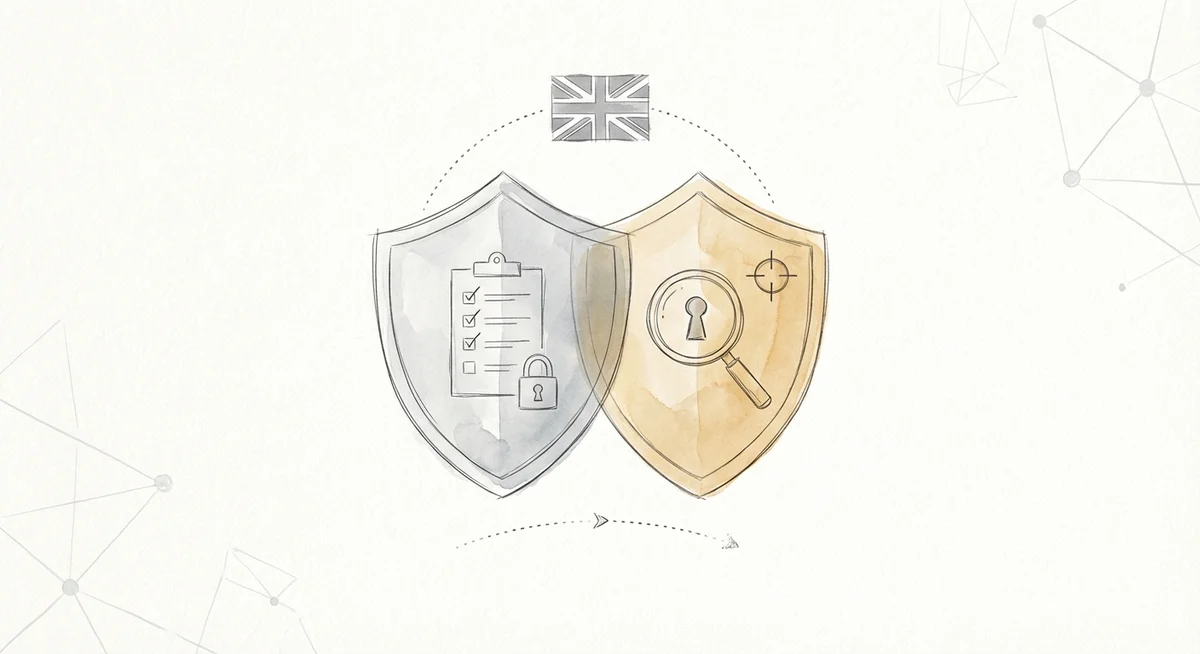
If you're responsible for cyber security at a UK organisation, you've almost certainly been asked about Cyber Essentials certification, penetration testing, or both. They show up together in procurement questionnaires, board reports and supplier due diligence forms, yet they serve fundamentally different purposes. Treating them as interchangeable is a common and costly mistake.
This guide explains what each covers, where they overlap, where they don't, and how to decide which you need based on your organisation's maturity, risk profile and budget.
What Is Cyber Essentials?
Cyber Essentials (CE) is a UK government-backed certification scheme designed to help organisations defend against the most common internet-based threats. It focuses on five technical controls:
- Firewalls: ensuring boundary devices are correctly configured to control inbound and outbound traffic.
- Secure configuration: removing or disabling unnecessary software, accounts and default settings.
- User access control: restricting administrative privileges and enforcing appropriate access policies.
- Malware protection: deploying anti-malware mechanisms or equivalent application controls.
- Patch management: keeping software and firmware up to date within defined timeframes (typically 14 days for critical and high-severity vulnerabilities).
These controls target what the NCSC calls "commodity" attacks: high-volume, low-sophistication threats that account for a large proportion of successful breaches. Think opportunistic ransomware, phishing that exploits unpatched software, or attackers scanning for open ports and default credentials.
Cyber Essentials vs Cyber Essentials Plus
The scheme has two levels, and the difference matters more than people realise.
Cyber Essentials is a self-assessment. Your organisation completes a questionnaire describing how it meets the five controls, and a licensed Certification Body reviews the answers. No one touches your systems.
Cyber Essentials Plus covers the same five controls but adds independent technical verification. A qualified assessor tests a sample of your devices, checks configurations, and confirms the controls you claimed are genuinely in place. This typically includes vulnerability scanning of internet-facing infrastructure, checks on endpoint malware protection, and verification of patching levels.
For a more detailed comparison, see our guide to Cyber Essentials vs Cyber Essentials Plus.
The key point: even Cyber Essentials Plus is not a penetration test. It verifies a fixed set of baseline controls. It does not attempt to exploit vulnerabilities, chain weaknesses together, or simulate an attacker moving through your network.
What Is Penetration Testing?
Penetration testing (pen testing) is an authorised exercise in which a qualified security professional simulates a real-world attack against your systems, applications or networks. The goal is to find exploitable vulnerabilities, demonstrate the potential impact of a breach, and provide actionable remediation guidance.
Unlike the fixed-control focus of Cyber Essentials, a penetration test is scoped to address the specific risks that matter most to your organisation. Common types include:
- External infrastructure testing, targeting internet-facing systems like firewalls, VPNs and mail servers.
- Internal infrastructure testing, simulating a threat actor who already has a foothold inside the network.
- Web application testing (WAPT), examining applications for injection flaws, broken authentication and access control issues.
- Cloud configuration reviews of AWS, Azure or Google Cloud environments.
- Social engineering through phishing simulations or pretexting.
A pen test is a point-in-time assessment. It reflects the security posture of that specific scope at the moment it was conducted, which makes regular re-testing important, particularly after significant infrastructure changes or new application deployments. For a broader overview of how software testing fits into this picture, see our guide to software penetration testing.
Where They Overlap and Where They Don't
There is a narrow overlap between Cyber Essentials Plus and penetration testing. Both involve some form of technical assessment. An external infrastructure pen test, for example, may catch many of the same patching or configuration gaps that a CE+ assessment would flag.
Beyond that, they diverge:
| Cyber Essentials / CE+ | Penetration Testing | |
|---|---|---|
| Purpose | Verify baseline hygiene controls | Find and exploit vulnerabilities across a defined scope |
| Scope | Five fixed controls | Tailored to the organisation's risk profile |
| Depth | Configuration checks and sampling | Creative, exploitative testing including chained attacks |
| Threat model | Commodity, automated attacks | Targeted and sophisticated scenarios |
| Output | Pass/fail certification | Detailed technical report with evidence and remediation priorities |
| Frequency | Annual recertification | Typically annual, or after significant changes |
| Standard | NCSC Cyber Essentials scheme | Often aligned with CREST, CHECK, OWASP or PTES |
Neither replaces the other. Cyber Essentials won't tell you whether a determined attacker could compromise your web application or escalate privileges across Active Directory. A penetration test won't certify your compliance with a recognised baseline scheme, and it won't systematically verify that every endpoint in your estate has current patches and active malware protection.
Common Misconceptions
"Cyber Essentials Plus is basically a penetration test"
This is the most widespread misunderstanding. CE+ checks only the five CE controls against a sample of systems. There is no attempt to chain vulnerabilities, escalate privileges, pivot between systems, or test application-layer logic. The methodology is entirely different.
"Cyber Essentials means we're secure"
Cyber Essentials is a baseline. The NCSC is clear that it addresses the most common threats, not all threats. It doesn't cover incident response, security awareness training, supply chain risk, or application-level vulnerabilities. Organisations that handle sensitive data or operate complex environments need more, whether that's penetration testing, ISO 27001, or both.
"A penetration test guarantees safety"
No single assessment can guarantee security. A pen test is a snapshot within a defined scope. Vulnerabilities outside that scope, introduced after the test, or arising from zero-day exploits won't be captured. The real value lies in the remediation that follows and in building a cycle of regular testing and improvement.
"We only need one or the other"
For many organisations, particularly those bidding for public sector or regulated contracts, both are expected. They address different questions: "Do we have basic hygiene in place?" versus "Could a skilled attacker compromise our critical systems?"
When Each Is Required: Procurement and Compliance
Cyber Essentials in procurement
Procurement Policy Note (PPN) 014 makes Cyber Essentials certification mandatory for many central government contracts involving personal data, sensitive information, or certain ICT products and services. Many local authorities and NHS trusts have adopted similar requirements. Beyond government, a growing number of private sector organisations require CE or CE+ from suppliers as a minimum standard. If you're in any supply chain where data handling is involved, expect to encounter this.
Penetration testing in procurement
For higher-risk environments, including Critical National Infrastructure (CNI), financial services, and systems processing large volumes of personal data, customers and regulators often require evidence of regular penetration testing. For government or defence contracts, testing may need to be conducted under the NCSC CHECK scheme by CREST-certified testers.
Regulatory frameworks including PCI DSS, the FCA's operational resilience expectations, and sector-specific NCSC guidance may all mandate or strongly recommend penetration testing at defined intervals.
How to Prioritise Based on Maturity, Risk and Budget
Not every organisation needs to do everything at once. A tiered approach based on where you are today usually works best.
Tier 1: Establish the baseline
If your organisation hasn't yet achieved Cyber Essentials, start here. It's relatively low cost, straightforward to implement (especially for smaller organisations), and addresses the controls that prevent the vast majority of opportunistic attacks. The NCSC estimates these five controls can protect against around 80% of common internet-based threats.
Typical profile: Small to mid-sized organisation, limited security resource, early-stage maturity, basic procurement requirements.
Tier 2: Gain independent assurance
Once the baseline is in place, Cyber Essentials Plus provides independent verification that your controls actually work. This matters most if you're supplying into sectors where clients want evidence beyond a self-assessment, or if you want to spot gaps between documented controls and reality.
Typical profile: Organisation growing into regulated or public sector supply chains, preparing for more advanced security investment.
Tier 3: Test against real-world threats
Commission penetration testing when you need to understand your exposure to targeted attacks. This is especially important if you have internet-facing applications (customer portals, APIs, e-commerce platforms), sensitive data at scale, complex or hybrid infrastructure, regulatory obligations that specifically require pen testing, or recent significant changes to your architecture.
Typical profile: Mid-sized to large organisation, moderate to high risk, regulatory obligations, customer-facing digital services.
Before engaging a provider, it's worth understanding the key steps to take before hiring a penetration testing company to ensure you scope the work properly and get meaningful results.
Tier 4: Continuous improvement
Mature organisations treat both Cyber Essentials and penetration testing as recurring activities within a broader security programme. Annual CE recertification maintains the baseline. Regular pen testing, at least annually and after major changes, provides ongoing assurance. Many organisations at this stage also pursue ISO 27001 to demonstrate a systematic approach to information security management.
Current Landscape
The Cyber Security Breaches Survey 2024 found that awareness of Cyber Essentials among UK businesses remains low, around 12%, though adoption is higher among larger organisations and those in regulated sectors. Many that achieve CE use it as a stepping stone toward more comprehensive measures.
On the pen testing side, the CREST Certified Tester (CCT) syllabus now covers cloud environments and containerisation, reflecting how much the technical landscape has shifted. Modern pen testing increasingly needs to address infrastructure that didn't exist when the scheme was first designed: serverless architectures, Kubernetes clusters, SaaS integrations.
The practical takeaway for UK organisations is that the threat landscape and the expectations of customers, regulators and insurers are all heading the same way: toward demonstrable, evidence-based security. Cyber Essentials and penetration testing aren't competing investments. They're complementary, addressing different layers of risk, and most organisations of any significant size will eventually need both.